Electromagnetic counterparts for Gravitational Wave events
1. Multi-Messenger Astrophysics
The detection of gravitational waves from compact binary mergers—such as neutron star-neutron star (NS–NS) and neutron star–black hole (NS–BH) systems—has opened a new window into the Universe. These events, while first observed through ripples in spacetime by detectors like LIGO and Virgo, are also expected to produce electromagnetic (EM) counterparts across multiple wavelengths. Identifying and studying these EM signals provides crucial insights into the physics of the merger, the nature of the ejecta, and the origin of heavy elements via r-process nucleosynthesis.
2. 170817
One of the most promising EM counterparts is the kilonova—a rapidly fading optical/infrared transient powered by radioactive decay of neutron-rich material ejected during the merger. The discovery of AT2017gfo, the optical counterpart to the first binary neutron star merger GW170817, marked the dawn of multi-messenger astronomy. Since then, coordinated efforts using wide-field and deep-imaging telescopes have been key to discovering similar events.
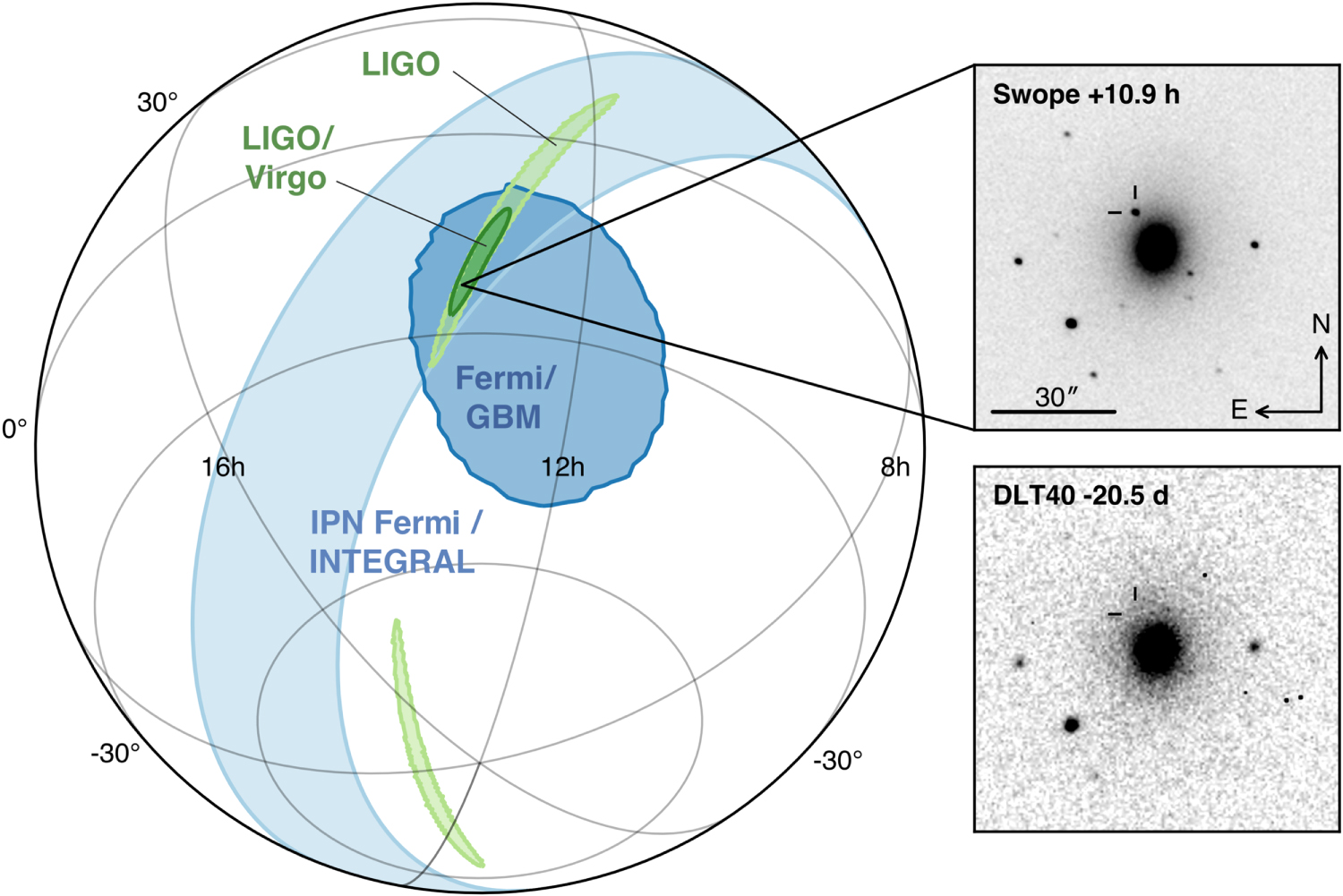
Figure: Sky Localization of the Gravitational, Gamma-Ray, and Optical Signals of GW170817 (Abbott et al., 2017)
3. Gold Hunting strategy
Facilities like the Zwicky Transient Facility (ZTF) and the Dark Energy Camera (DECam) play a vital role in this search. ZTF enables rapid tiling of large localization regions from LIGO–Virgo alerts, while DECam provides deep follow-up to identify faint kilonova candidates. The GROWTH-India Telescope contributes real-time photometric monitoring from a different geographic longitude, increasing cadence and sky coverage. These facilities work in synergy to detect and characterize EM counterparts before they fade away.
4. Current status
The fourth observing run (O4) of the LIGO–Virgo–KAGRA collaboration began in May 2023 and continues to deliver a wealth of gravitational wave alerts. With enhanced detector sensitivity and real-time public notifications, the search for electromagnetic counterparts has entered a new era of precision and responsiveness. Among the most promising alerts is S250206dm, a high-significance binary neutron star (NS–NS) merger candidate reported by LIGO. The Zwicky Transient Facility (ZTF) carried out wide-field tiling of the event’s localization region, while the GROWTH-India Telescope (GIT) provided targeted follow-up observations from Hanle, India. These coordinated efforts aimed to identify potential kilonova signatures and constrain the merger’s origin and properties.
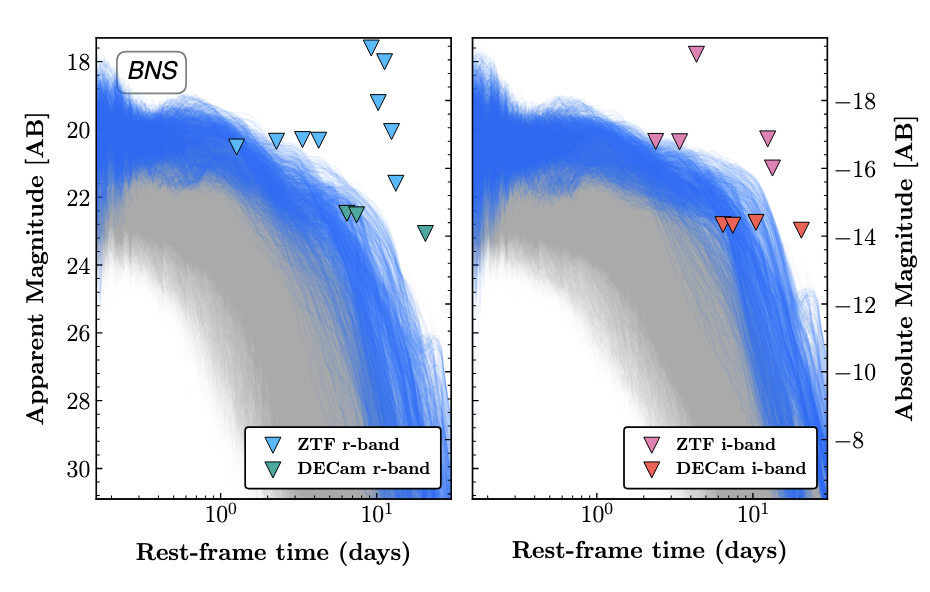
Figure: Light-curves of BNS models pinned at 269 Mpc, the closest 1-sigma from the GW distance distribution. The ZTF and DECam median upper-limits as triangles for (left) r band and (center) i band. BNS models were ruled out by both ZTF and DECam at different stages in the lightcuve